ADF Art Gallery Project Vol.49 | Koji Ochiai Solo Exhibition “Agua y Viento 1980s”
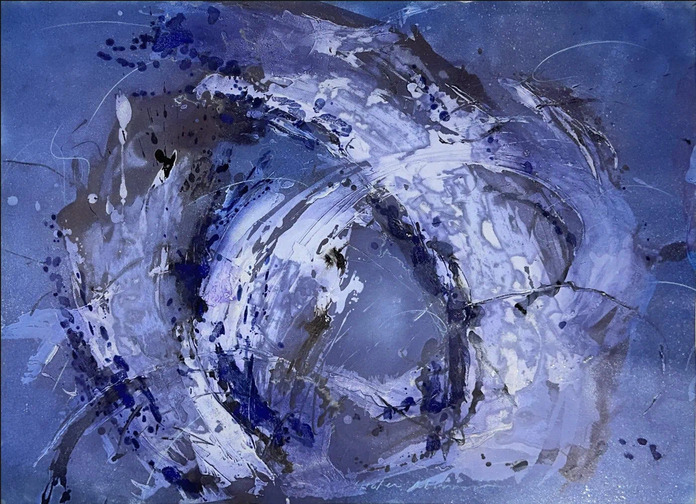
Koji Ochiai, water mirror, 1988, mixed media (collagraph plate)
What Koji Ochiai Left Behind: Tracing the Legacy of an Artist Shaped by a Turbulent Spain
ADF (Aoyama Design Forum, NPO) will present Agua y Viento 1980s, a printmaking exhibition by Japanese artist Koji Ochiai, as the 49th edition of the ADF Art Gallery Project. The exhibition will be held at GARDE Gallery in Omotesando from Friday, October 9 through Wednesday, October 21, 2026. An opening reception will take place on Friday, October 9, from 6:00 to 8:00 p.m. The event is open to everyone, and visitors are warmly invited to attend.
Painter and printmaker Koji Ochiai attracted widespread attention following the Fuji TV documentary The Nonfiction: I Never Knew My Father Who Died in the Flames, which aired over three consecutive weeks at the end of 2024 and received a Gold Award at the World Media Festival 2026. This exhibition presents a selection of works entrusted to Ochiai’s son, Yosuke, tracing the artist’s development from the years preceding his professional debut through the 1970s and 1980s, when he was selected as one of the “150 Spanish Artists” alongside figures such as Pablo Picasso and Salvador Dalí.
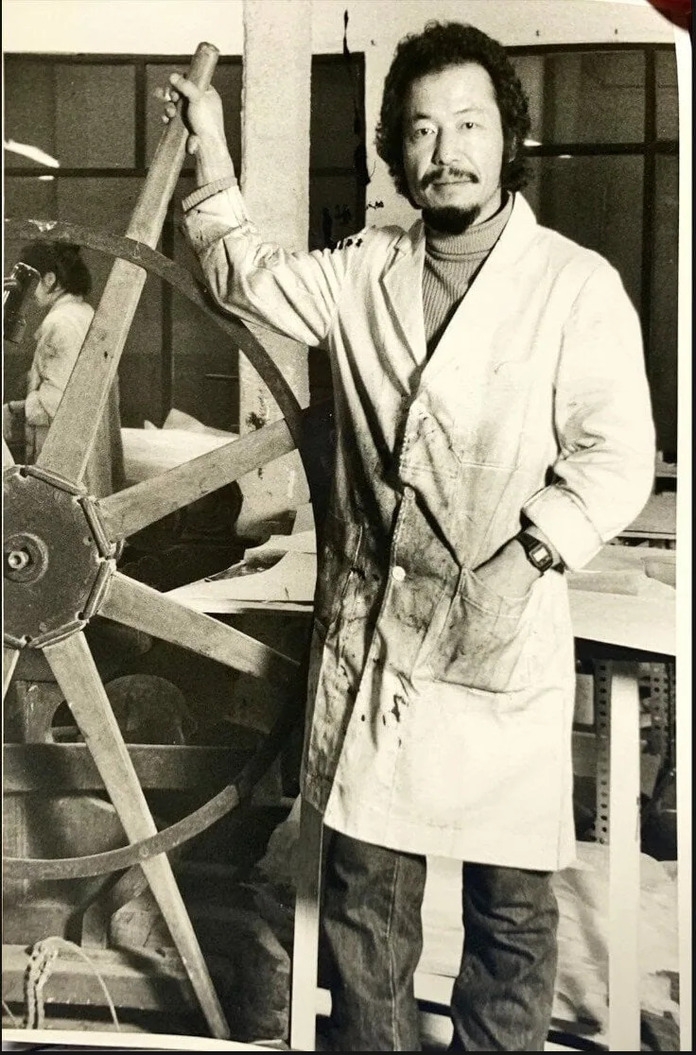
Koji Ochiai (Painter and Printmaker, 1948–2024)
In 1968, Koji Ochiai, a young man from Nagano, struggled to identify with the prevailing atmosphere of an era dominated by student activism. Having failed his entrance examination for an art university and spending a year preparing to retake it, Ochiai found greater meaning in visiting museums with his closest friend and listening to the music of Bill Evans and Miles Davis than in the loudly proclaimed ideologies of the time.
That same year, through connections provided by his Christian mother, Ochiai was given the opportunity to study at the Royal Academy of Fine Arts of San Jorge in Spain. At the time, Spain was under the dictatorship of Francisco Franco and was a world marked by even greater tension and turmoil than Japan. Within this repressive environment, artists were searching for ways to express themselves. Following the spirit of Picasso’s Guernica, which denounced fascism, artists such as Joan Miró and Antoni Tàpies embedded political messages in symbols and abstract forms in order to evade censorship. Printmaking was one of the most powerful means of expression available to them. Ochiai’s encounter with the medium would profoundly alter the course of his life.
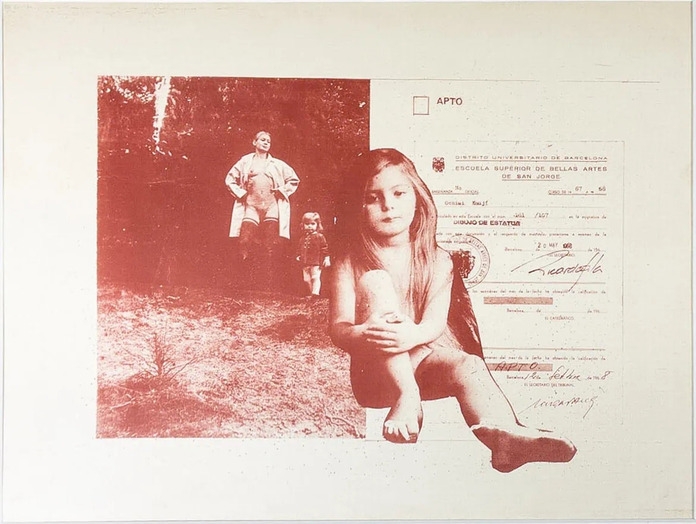
Koji Ochiai, untitled, 1970s, photo etching
After returning to Japan, Ochiai worked as a professional designer but remained deeply impressed by the expressive power of printmaking he had experienced in Spain. He subsequently resumed his studies at the printmaking department of Sokei Academy of Fine Art. The skills he developed there were highly regarded in Spain, and in 1978, at the age of 30, he returned to the country with his wife.
At Studio 44, Barcelona’s oldest printmaking workshop, Ochiai worked as a printer for artists including Miró and Tàpies. He eventually went on to teach lithography at the Royal Academy of Applied Arts in Spain. Then, in 1980, following the birth of his son, Yosuke, he began pursuing his own career as an artist.
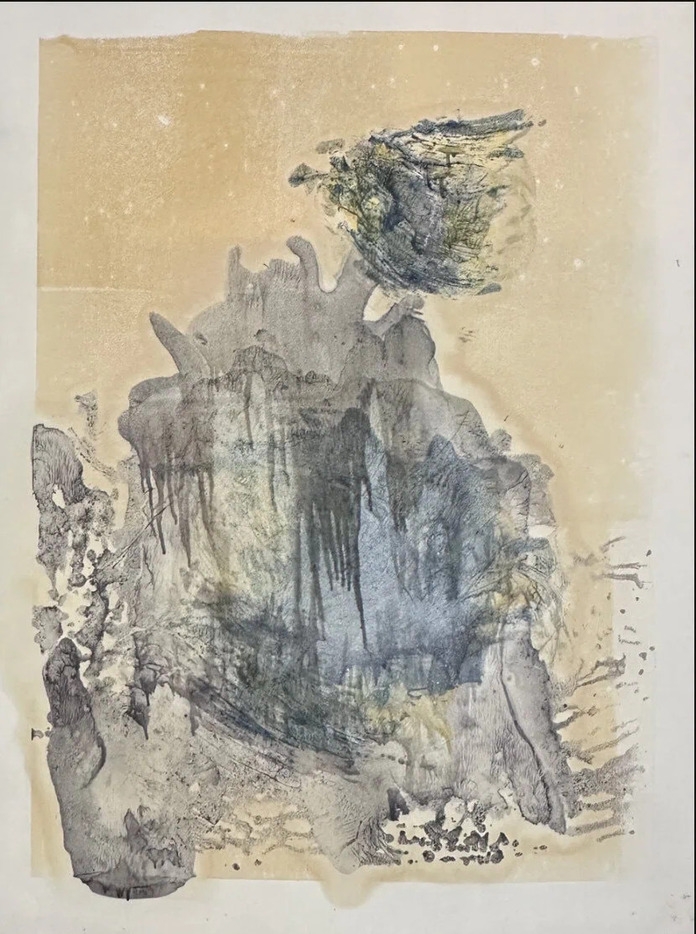
Koji Ochiai, water mirror, 1980s, lithograph
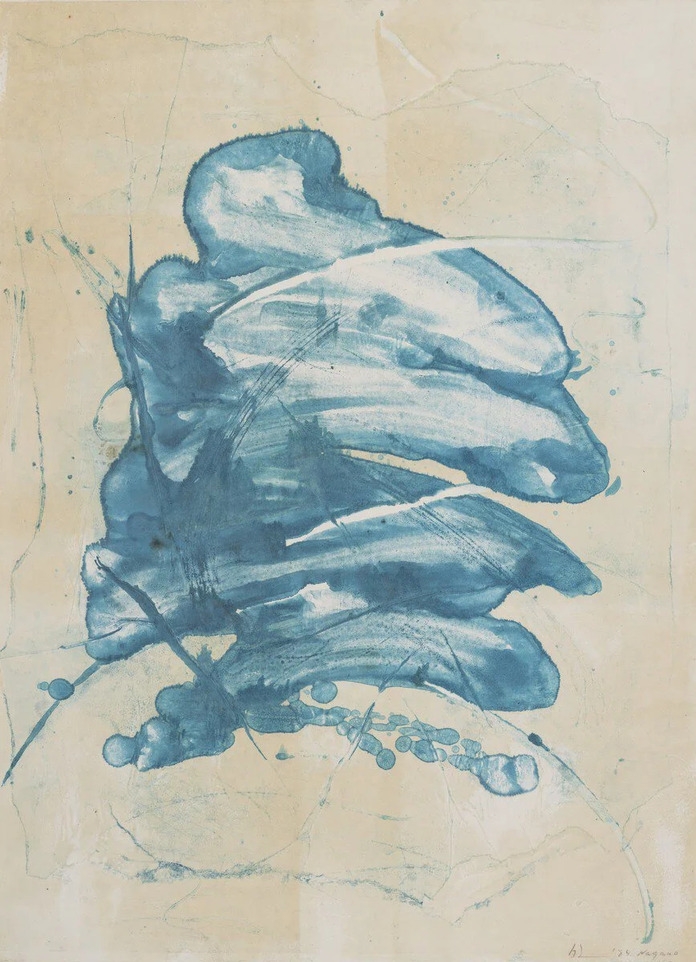
Koji Ochiai, water mirror, 1984, lithograph
As Ochiai continued to develop his prints through exchanges with painters, poets, musicians, and other artists, two subjects gradually came to occupy a central place in his work: wind (Viento) and water (Agua). His works were subsequently acquired by the National Library of Spain, and in 1989 he was recognized as one of the “150 Spanish Artists,” alongside Picasso, Miró, Tàpies, Dalí, and other leading figures. During the decade following his return to Spain, Ochiai established an accomplished artistic career.
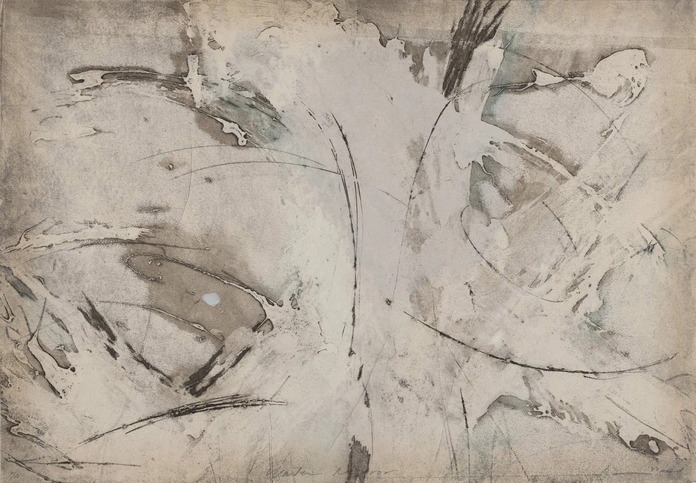
Koji Ochiai, water mirror, 1988, collagraph (work selected for “150 Spanish Artists”)
Later, at the wishes of his family and relatives, Ochiai moved his base of activity back to Japan. Traveling between Japan and Europe, he continued to produce ambitious works, including a collaboration with French writer Michel Butor. Yet his financial circumstances never improved. Even as he lost family members, friends, and material possessions, he never relinquished his brushes, continuing to produce an uncountable number of paintings. In 2024, however, he died in an accidental fire. The continuation of his story was subsequently entrusted to his son, Yosuke.
The exhibition traces Ochiai’s artistic journey from his departure for Spain to the period when he emerged as a distinguished printmaker, presenting works alongside the changes in his life and artistic development. Through the trajectory of Ochiai’s thoughts and sensibility, the exhibition invites visitors to encounter the distinctive world he created.
On Saturday, October 17, 2026, the exhibition will also host a talk event titled Where Does Art Reach?. Hideaki Kawabata, Professor at the Faculty of Letters, Keio University and a specialist in neuroaesthetics and experimental aesthetics, will discuss works by Miró, Tàpies, and Ochiai from the perspectives of psychology and neuroscience. The conversation will be moderated by Ochiai’s son, Yosuke Ochiai.
ADF Art Gallery Project Vol.49 | Koji Ochiai Solo Exhibition “Agua y Viento 1980s”
Dates
October 9 - October 21, 2026
Time
11:00–18:00
Venue
GARDE Gallery
Reception
October 9, 18:00–20:00
Address
4F NBF ALLIANCE Building, 5-2-1 Minami-Aoyama, Minato-ku, Tokyo
URL
https://www.art-adf.jp/?sl=en
Note
Please refrain from asking for directions to the exhibition venue at the shop located on the first floor of the building.
